
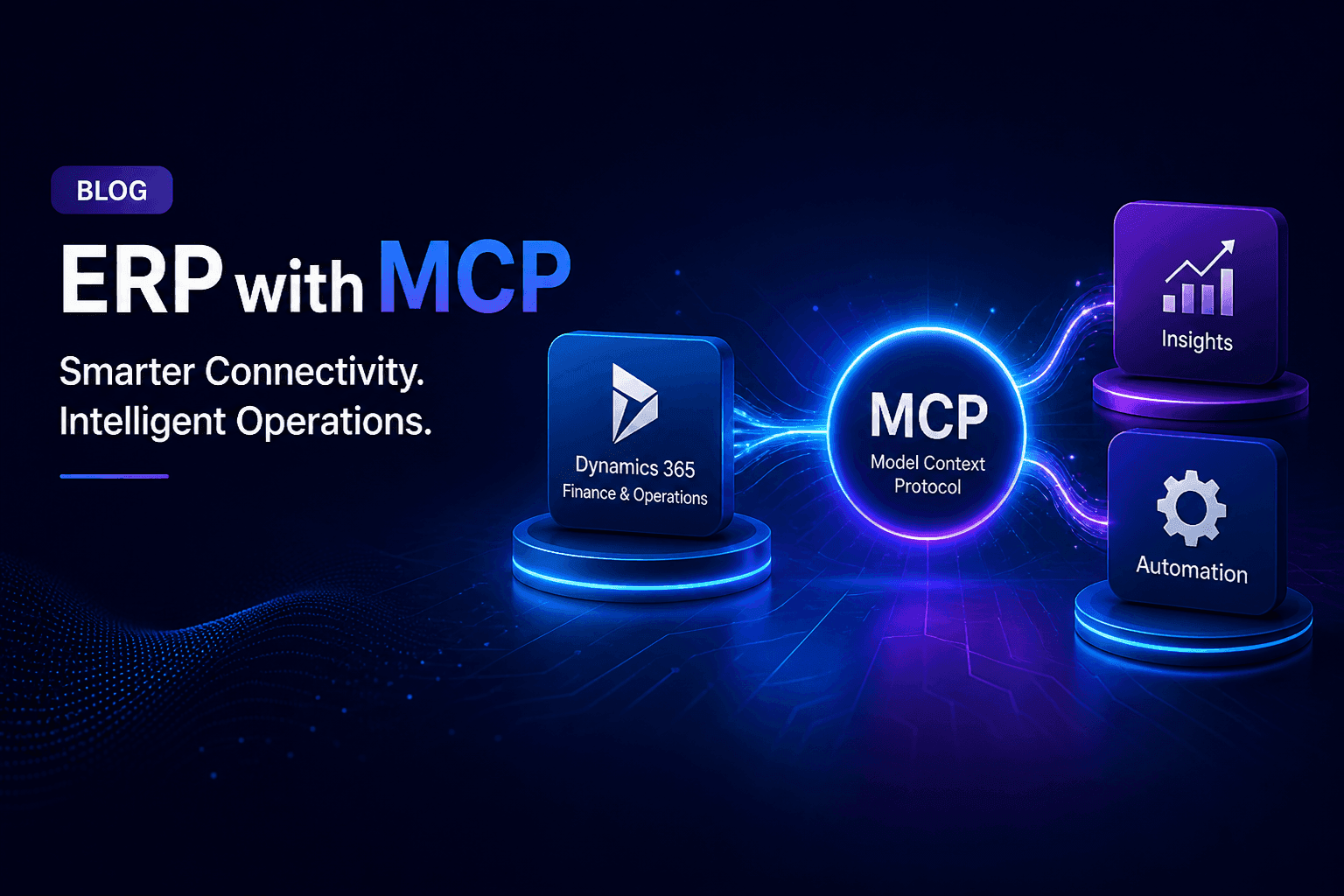
ERP Is Moving Beyond Transaction Recording
In today’s fast-evolving business landscape, organizations expect ERP systems to do more than record transactions. They need platforms that can analyze, predict, and automate.
This is where Model Context Protocol (MCP) is emerging as a powerful concept, especially when integrated with Microsoft Dynamics 365 Finance and Operations.
What Is Model Context Protocol?
Model Context Protocol is a structured approach that allows AI models and external systems to interact with enterprise data in a contextual, secure, and standardized way. Instead of exchanging only raw data, MCP helps AI understand the business context behind ERP information.
- Context-aware communication
- Intelligent decision-making
- Real-time insights driven by AI
- A secure bridge between ERP data and AI-driven intelligence
Why MCP Matters in D365 Finance and Operations
Dynamics 365 Finance and Operations already provides strong capabilities for finance, supply chain, and operations. MCP enhances those capabilities by introducing AI-native interactions that can interpret business context and recommend action.
- Context-driven automation that understands why something is happening
- Seamless integration with copilots, custom AI services, and agent workflows
- Improved decision-making through real-time insights and exception-based alerts
- Standardized data interaction for external applications, APIs, and AI services
How MCP Works with D365 FO
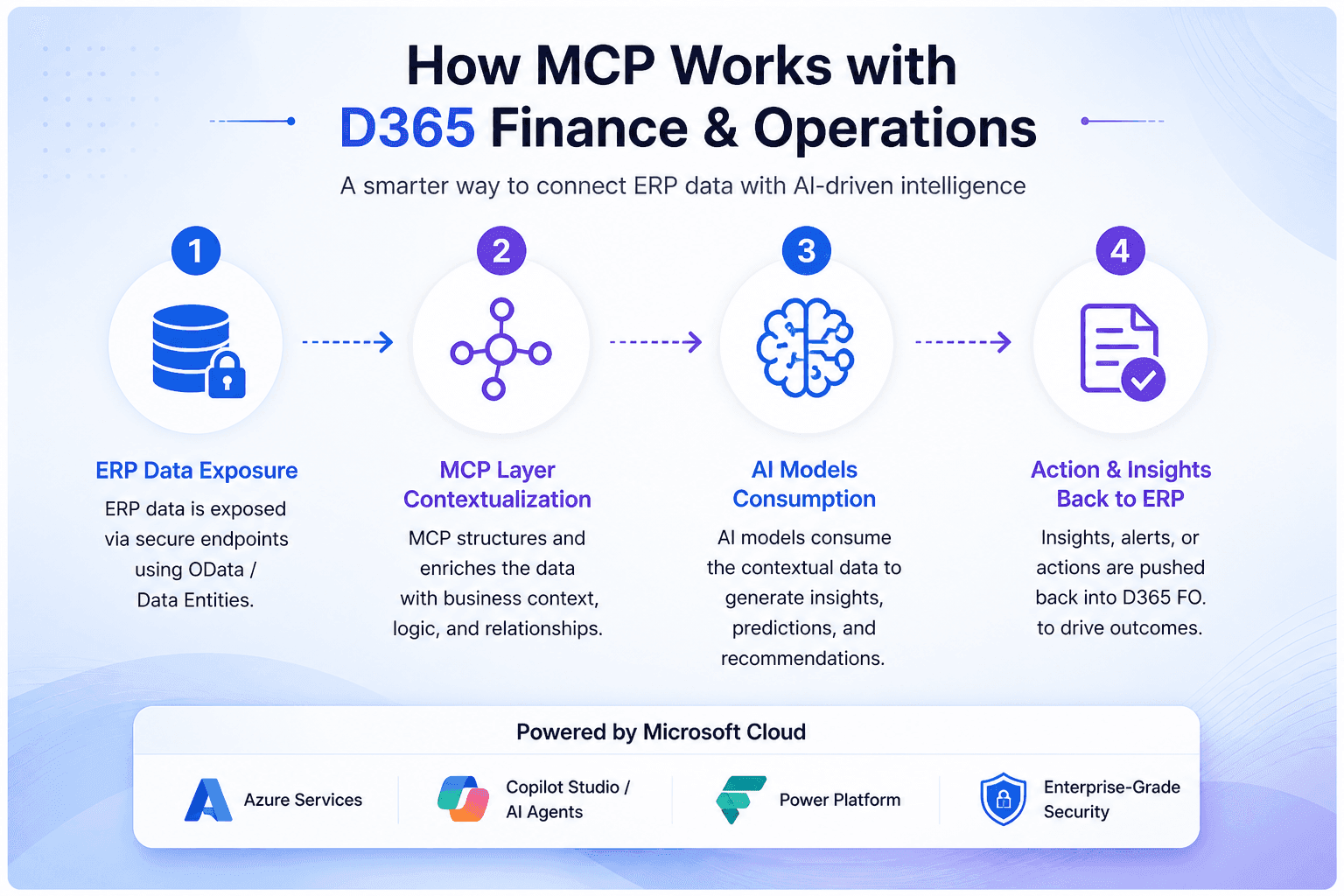
In a D365 FO environment, MCP can be implemented by combining secure ERP data exposure, business logic services, Azure orchestration, and intelligent user experiences through Copilot Studio or AI agents.
- OData and Data Entities for structured data exposure
- Custom Services in X++ for business logic execution
- Azure Services for AI orchestration and integration
- Copilot Studio or AI agents for natural language interaction
Typical MCP Flow
The MCP layer structures and contextualizes ERP data before an AI model consumes it. Insights or actions can then be pushed back into Dynamics 365 Finance and Operations through governed workflows.
- ERP data is exposed through secure endpoints
- The MCP layer structures and contextualizes the data
- AI models consume the business context
- Insights, alerts, or actions are delivered back to users or D365 FO
Real-World Use Cases
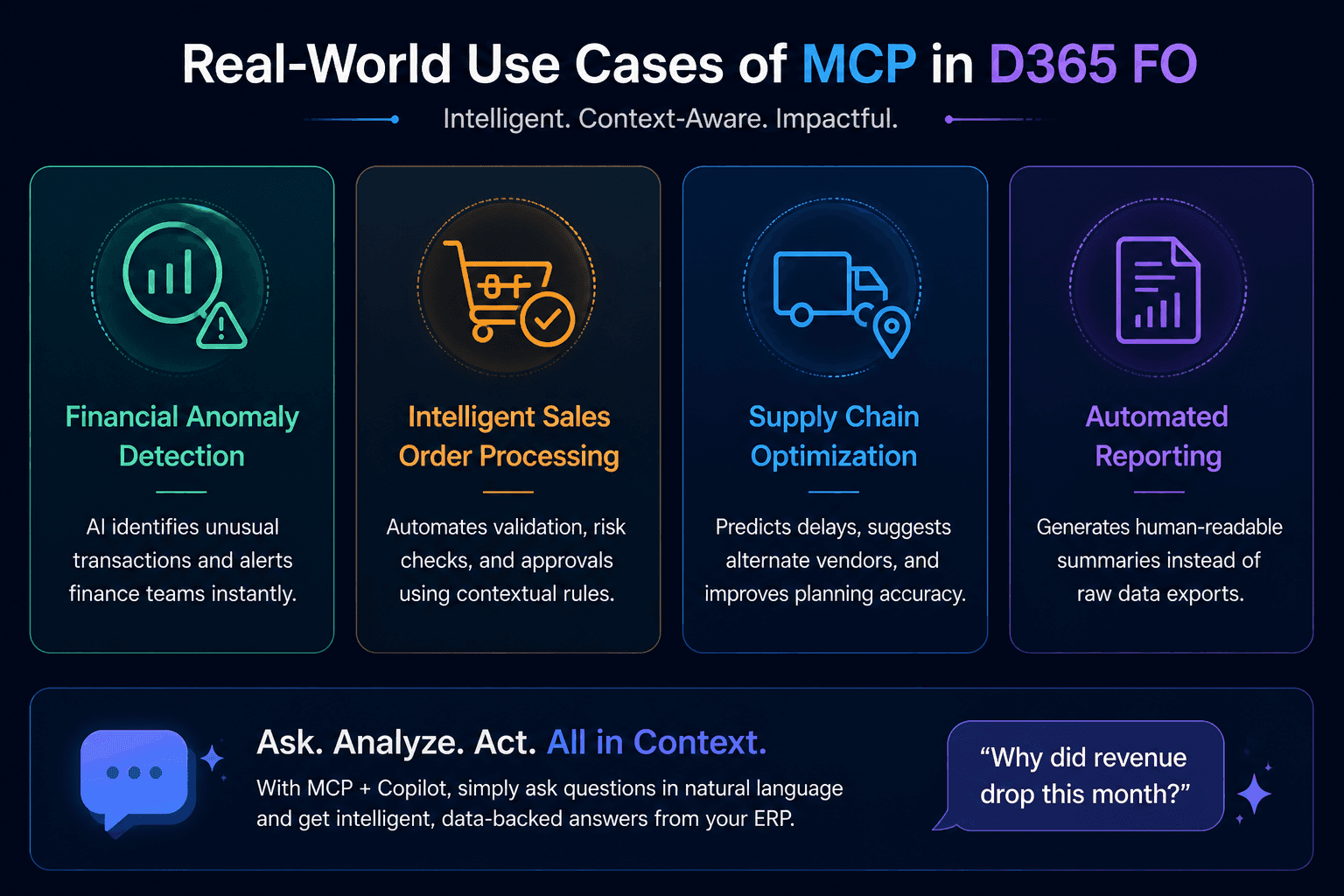
MCP becomes especially valuable when ERP teams need faster decisions, automated checks, and readable business explanations from complex operational data.
- Financial anomaly detection for unusual transactions
- Intelligent sales order processing with validation, risk checks, and approvals
- Supply chain optimization with delay prediction and alternate vendor suggestions
- Automated reporting that produces human-readable summaries instead of raw exports
MCP and Copilot: The Future of ERP
With tools like Copilot Studio, MCP enables natural language queries, AI-generated insights, and automated workflows. A user can ask why revenue dropped this month and receive a contextual, data-backed answer from D365 FO.
Challenges to Plan For
MCP introduces a powerful operating model, but organizations should design it carefully. Security, API quality, performance, governance, and user adoption all matter.
- Data security and governance
- Performance optimization
- Proper API and service design
- Change management for business users
Conclusion
ERP MCP is not just a technical upgrade. It is a shift toward intelligent, AI-driven enterprise systems.
By integrating MCP with Dynamics 365 Finance and Operations, organizations can move from reactive to proactive operations, empower users with real-time intelligence, and unlock the full potential of AI in ERP.